
LAB CREATED DIAMONDS
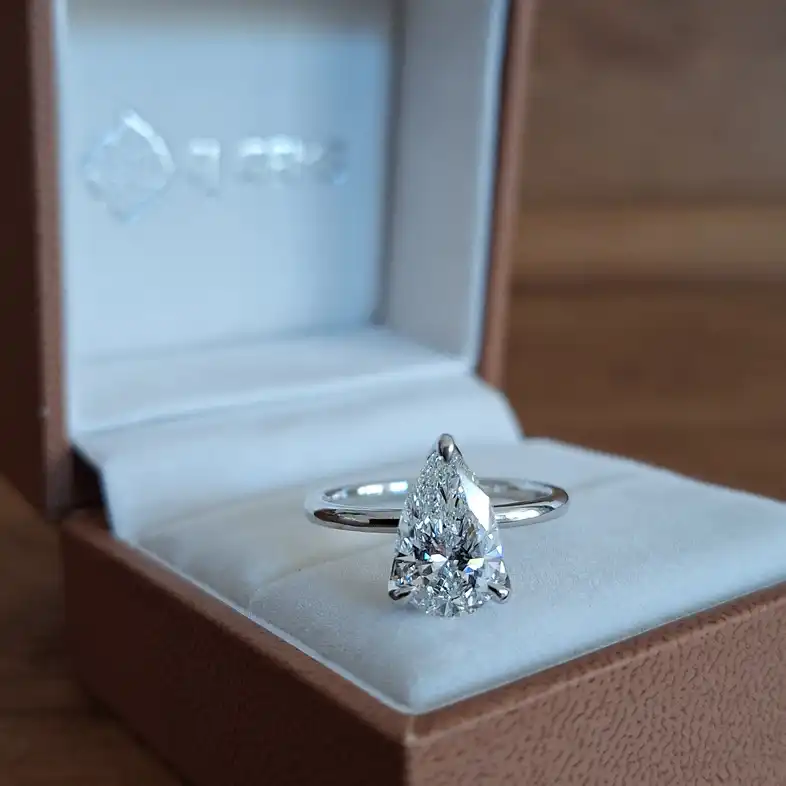
Pear Cut Diamonds
The pear shape has a modified brilliant cut with 58 facets, combining the rounded end of an oval with the pointed tip of a marquise. Its most practical advantage is size — a pear shaped diamond has approximately 8% more surface area than a round, meaning it faces up noticeably larger. It is also typically 10–30% less expensive than a comparable round diamond.
Symmetry is the single most critical quality factor in a pear. The point must align exactly with the apex of the rounded end, and both wings must form perfectly mirrored curves. Even a slight asymmetry is immediately visible once the stone is set. Always insist on Excellent symmetry.
Beyond the 4Cs: Use the
proportions table to identify the
finest stones in our collection.
| Proportion | Ideal range | Why it matters |
|---|---|---|
| Table % | 57% – 62% | Balances brilliance and fire |
| Depth % | 58% – 64% | Controls light return |
| Length to width | 1.45 – 1.55 | Determines elongation of the shape |
| Polish & symmetry | Excellent | Symmetry is critical |
| Girdle | Thin – Thick | Protects the delicate point |
- Excellent
- Excellent
- None
- GIA
- IGI
-
 0.33ct · Emerald I VVS2 LAB
 -
 0.31ct · Round D VS1 LAB
 -
 0.38ct · Round D VS1 LAB
 -
 0.34ct · Round E VS1 LAB
 -
 0.34ct · Round E VS1 LAB
 -
 0.34ct · Round E VS1 LAB
 -
 0.34ct · Round E VS1 LAB
 -
 0.34ct · Round E VS1 LAB
 -
 0.34ct · Round E VS1 LAB
 -
 0.34ct · Round E VS1 LAB
 -
 0.34ct · Round E VS1 LAB
 -
 0.32ct · Round E VS1 LAB
 -
 0.32ct · Round E VS1 LAB
 -
 0.31ct · Round E VVS2 LAB
 -
 0.34ct · Round D VS1 LAB
 -
 0.34ct · Round D VS1 LAB
 -
 0.34ct · Round D VS1 LAB
 -
 0.34ct · Round D VS1 LAB
 -
 0.34ct · Round D VS1 LAB
 -
 0.34ct · Round D VS1 LAB